Sunday, November 27, 2011

Fail of the Day

While I love my church, it usually takes me an hour or more to get there on the subway, best case scenario, after which I have to walk about a mile to actually reach the church building. Since I have a new bike, I decided that this morning I would try to bike there instead. It’s only about eight miles by Google Maps’ reckoning, so I thought I’d have a nice, scenic ride instead of two hours of dark subway time.

Scenic? Yes. Nice? Not so much.

Turns out, at about the midpoint on the route I plotted between my house and my church, the Potomac River courses through a valley so steep that, according to the historical markers on the way, the Union Army used is as a natural defense for the Capital against the advancing rebel army.


Robert E. Lee I am not.

The bike path descends sharply downward into the valley, crosses the massive Chain Bridge, and then promptly runs into a highway with “no biking” signs posted everywhere. On the other side of the highway was a hill even steeper than the one I had just come down.

At that point I was already ten minutes late for church. So, I pushed my bike back up out the valley and pedaled sadly home.

At least it was a nice day.

Friday, November 25, 2011

Book Review: The Unmaking of Israel by Gershom Gorenberg

I love Gershom Gorenberg. He is a magnificent storyteller, a bold whistleblower, a clear-minded historian, a sober analyst and a humble advocate. His books and writings, while almost exclusively devoted to Israeli history and politics, have a way of illuminating politics as a whole.

Gorenberg is an American-Israeli historian and journalist. I had the honor of hearing him speak in Jerusalem three years ago, and I have been a devoted fan ever since. I based one of my final papers in college on his book The Accidental Empire, which I’ve found myself coming back to over and over again ever since. And so, when I heard about his latest work, The Unmaking of Israel, I ordered it almost immediately.

The book does not disappoint. Instead of focusing on settlements or the conflict, Gorenberg examines the history of the Israeli political system as a whole, from the near-civil war between the Labor Party and hardline nationalists in 1948 to the division and paralysis of the present day.

Palestine-sympathizers are perpetually flabbergasted at the sheer ferocity and dogmatism of U.S. support for Israel. It seems completely disproportionate to America’s actual interest in the matter. What could possibly explain this?
they ask.

While some blame apocalypse-minded evangelicals, some cite the influence of the Israel lobby, and some see Israel as a projection of colonial power, I would argue that, while all of those explanations are true to some extent, the biggest factor in America’s unyielding support for Israel is our perceived cultural similarities. We look at Israel, and see ourselves – a first-world, secular-but-religious, democratic, filthy-rich, high-tech society with a shady (to say the least) founding story, under assault from Islamic terrorists.

A huge part of our getting over this most entangling of alliances will be to begin to see ourselves in the Palestinians as well. The Unmaking of Israel accomplishes the opposite. Gorenberg strips the mask of civilization off of Israeli politics, and shows us the tribalism and savagery at its core.

One priceless example from pg. 149: After listing some prominent Orthodox rabbis who have spoken out in favor of the rule of law in Israel, Gorenberg comments, “They provide a reminder – sadly necessary at the moment – that Orthodox Judaism and democracy are compatible.”

Judaism and democracy are “compatible”? That’s the way Westerners talk about Islam. Surely speaking about the State of Israel in the same way is beyond the pale.

Well, no. It only seems that way because Israel shares so many of our cultural trappings.

In fact, Israel is a land where the military’s chief rabbi proclaims that an army medic should allow a wounded gentile to die rather than break the Sabbath, where state money is used to build homes for one ethnic group on land stolen from another, where the government can only rely on certain (and few) military and police units to enforce the law, or risk mutiny and perhaps civil war, where the foreign minister openly advocates redrawing the country’s borders to exclude its minority citizens.

Gorenberg’s sobering conclusion: Zionism and Israel have failed to “graduate from being an ethnic movement to being a democratic state in which all citizens enjoy equality.” If Israel does not succeed in implementing the rule of law on its territory (and defining the borders of that territory), it will collapse into “a territory marked on the map, between the river and the sea, where the state has been replaced by two warring communities.”

As I said before, Gorenberg’s writing about Israeli politics has a way of illuminating all of politics. Seeing Israeli politics for what it is can help us in the States to do the same with our own. Americans tend to think of our political system as different in kind, not just degree, from the totalitarian menaces of the 20th century and the dictatorships and failed states of the modern era. We have elections. We have separation of church and state. We don’t target civilians in our wars.

And yet.

And yet, our politics, our magnificent constitution and checks and balances and educated citizenry produced the wars in Iraq and Afghanistan, the deaths of hundreds of thousands of civilians, the oppressive and one-sided politics of the IMF and World Bank, and scores of client dictatorships around the world.

To those on the outside, does the distinction in the manner in which these policies were arrived at matter so much? Are these disasters so easy to dismiss as aberrations in a system that otherwise delivers peace and justice? Is the destruction of Iraq merely a stumbling block on the road to the “least bad” political reality? Or is it a symptom of a political system that is just as rotten as those we vilify in our press and public rhetoric?

Anyway. It’s a great book, and I would recommend it to all students of politics and the Middle East.

Now that I’ve praised it to the firmament, let me enumerate its flaws.
Gorenberg is a forceful advocate of the two-state solution. One state for the Jews, one state for the Palestinians. Self-determination for all, everybody’s happy.

His argument against the “one-state solution” – one man, one vote, one government for all the Jews and Palestinians in the land – is that, “A single state would not be a solution – or even a workable arrangement… It would be a nightmare: another of the places marked on the globe as a country in which two or more communities do battle the most educated or well-connected members of each look for refuge elsewhere.” Gorenberg cites Lebanon as an example.

Yes, of course, it would be a disaster. And yet, The Unmaking of Israel does not seem to offer a way to avoid that outcome. Just because Lebanon is a perpetual mess does not make a “four-state solution” (Christian, Sunni, Shia, Druze) possible there. So too with the Jews and the Palestinians.

Gorenberg knows exactly what must be done save his country. The tragedy is that, in explaining what must be done, he demonstrates its impossibility.

One example: Gorenberg writes, “Ending the occupation is…the precondition for disestablishing religion and creating equality for the Arab minority.” This, he says, is because the occupation makes it politically impossible to include political parties representing Israel’s Arab minority in coalition governments, thus giving small Jewish ultra-Orthodox parties effective veto power on things like civil marriage and religious education.

This is akin to arguing that, in order to get into the car, we will need to drive to the locksmith.

A political party that has the power to block, say, civil marriage, most likely also has the power to block the surrender of the Holy Land, yes?

And once Israel somehow achieves a coalition government willing to end the occupation, how will it be accomplished? There are over 500,000 Jews living on occupied territory. As Gorenberg admits, even with the most creative redrawing of borders and land swaps, 65,000 settlers, at a minimum, will have to be evacuated to create a Palestinian state.

As Gorenberg details in the book, removing just 9,000 settlers from Gaza required a combined force of 25,000 soldiers and policemen, or almost three security officers per settler. The operation utilized 10,000 police, a third of Israel’s police force, which was called upon because Israel’s leaders were uncertain if the army could be counted on to carry out the evacuation without mutinying.

Will the Israel Defense Forces really carry out the biggest forced expulsion of Jews since 1948? Will Jewish soldiers deport Jews from Bethlehem and Hebron and Shechem and Jerusalem?

The uber-depressing reality of this conflict is that it has the potential to continue for decades, if not a century. While American presidential candidates grandstand about their unswerving support for Israel, Israel’s own policies have very likely already doomed it to dirty ethnic conflict for the foreseeable future. Two-state? One-state? Probably, none of the above.

For all the talking that gets done about Israel in this country, I rarely hear these realities acknowledged. If we’re going to continue butting in to this conflict, then it’s our responsibility to listen to voices like Gorenberg’s. There may yet be hope.

Wednesday, November 16, 2011

Speaking the Queen's

About that last post...sorry if it threw you for a loop. Sometimes I get grandiose notions about writing here in Arabic EVERY DAY, and slowly building a bilingual audience. Then I actually try it, and it takes me half an hour to write three paragraphs, and I scale back my ambitions slightly.

...

I have a permanent place to stay, but not a permanent place to sleep.

I shall explain.

For the first five weeks I was in DC, my best friend since I was 9, Adam, let me crash on his futon in his tiny apartment in Arlington. This was a good arrangement, and I'm blessed to have friends as generous as him, but I clearly needed a place of my own.

I had originally planned to housesit for some Dordt alums in the area who were selling their place. That didn't work out in the end. So I got on the interwebs, and found a great house out in a suburb called Falls Church. There are six other Christian guys living here, most of whom have jobs in the city, and a few of whom are going to seminary.

So I moved into the house's basement two weeks ago. It's really nice, and very spacious - it has a kitchen, a living room and a bathroom. My housemates are great, although they're pretty busy. One of them works on for a congressman on the hill and rides the same train as me and reads the same science fiction novels as me. So that's pretty special. Another went on the exact same study abroad program as me a year after I did!

All of which is to say, it's very nice to be grounded for the first time in a while. But the basement apartment is unfurnished. And I haven't had the time to go bed shopping. So I've been sleeping on an air mattress for the past two weeks.

I'll get around to it. Eventually.

...

Almost every Sunday since I moved here, I have attended services at the Arabic Baptist Church, in the northwest corner of the District. I went the first Sunday I was here, the congregation welcomed me very warmly, and I understood a lot more of the sermon than I thought I would, so I've kept going. The congregation is made up almost entirely of Arab immigrants and their families - from Egypt, Syria, Lebanon, Palestine, Iraq, and elsewhere. I feel very blessed to have found this congregation, and honored by their welcome. The only hitch is that it's kind of far from my house. Hopefully I'll be able to keep going.


...

LAST Sunday though, my good friend Jordan, who was in Syria with me and now, providentially, is working with the Mennonite Volunteer Service in the District


invited me to go to a Syriac Orthodox Church service in Virginia. A bishop he knew from his time in Syria was visiting, and he wanted to see him.

Like the Coptic Orthodox Church in Egypt, the Syriac Orthodox Church preserves the language of the Christians of Syria from before the Arab-Muslim conquest in the 7th century. That language is Syriac, a dialect of the Aramaic spoken by Jesus and his followers, and still widely spoken in Syria today.

The mass was awesome! The ushers gave us books that printed the entire liturgy in English, Syriac, and Syriac-transliterated-into-English-letters so we could chant along with the congregation. It amazed me how similar Arabic and Syriac are. Still, I was able to tell when the bishop stopped speaking in Syriac and started speaking in Arabic. There was no apparent rhyme or reason to which of the three languages was spoken at any one time. It was exhilarating.

...

My brother Simon and his friend Matt came to visit two Saturdays ago, my first weekend in the new house. They were kind enough to drive my parents' car home for me (I hate city driving, and I love the DC Metro), but that took them all day Sunday, so we had to pack all of our activities into Saturday. To that end, I marched them out the door at 9:00 AM and didn't bring them back until 10:00 PM.

We had a great time! Though, barring an imminent proletarian revolution, I'm pretty sure I've got some career-devastating dirt on my bro.


"Let a unbathed COMMIE teach our kids math? Not my Jimmy!"

...

Also - ALSO! - I am sharing my massive new basement apartment with one of my best friends from college, Proconsul Alvin Shim himself. His is a life to be imitated by all lost 20-somethings out there in Recessionland. Fresh off a year of teaching English in Korea, when I told him I was moving to DC for work, he decided to move here too - to job search. I have never done anything that courageous. I have no doubt he'll find work soon. Any company would be lucky to have him. And I am very blessed to have his company and wisdom. Here's to you, pal.


...

Work is good. But I can't really talk about it. Omar B. is probably watching this page...

...

With a paycheck comes an illusion of riches. I recently succumbed to this illusion by buying five books on Amazon, sheerly for pleasure.

Two days ago, the first three arrived. The Unmaking of Israel by Gershom Gorenberg, Islam Without Extremes by Mustafa Aykol, and Formic Wars: Burning Earth, by Orson Scott Card.

Ohmygoshimsoexcitedicanhardlywaittofinishallthree...No. No. Have to pace myself.

...

Speaking of books, my friend Adam (not the guy who let me crash on his futon) recently asked me this:

"What books were foundational for you? I'd like to read more but I don't know where to start. A budding Pacifistic Socialist needs some guidance."

Pacifistic socialist? Slow down, Karl.

The Accidental Empire by Gershom Gorenberg
Sowing Crisis: The Cold War and American Dominance in the Middle East by Rashid Khalidi
The Kingdom of God is Within You by Leo Tolstoy
The Unconquerable World by Jonathan Schell
Night Draws Near by Anthony Shadid
The Future of Freedom by Fareed Zakaria
The Inescapable Love of God by Thomas Talbott
The Subversion of Christianity by Jacques Ellul
The Case for Democracy by Natan Sharansky
The Scandal of Evangelical Politics by Ronald Sider
Living in the End Times by Slavoj Zizek
Jesus for President by Chris Haw Shane Claiborne (why lie?)
Red Prophet by Orson Scott Card
Lies My Teacher Told Me by James Loewen
Until Justice and Peace Embrace by Nicholas Wolterstorff

Mind you, these are simply the books I've read that influenced me the most. There are almost certainly better books out there.

What do you think, readers? Which books would be on your list?

...

If it's all the same to you guys, I'm not going to blog much more about the 2012 presidential race. What more is there to say than this: we live in an age and a country where the national frontrunner can forget which country we were at war in last, where our news media is so nihilistic that the only question they ask about any occurrence or utterance is, "Will this help/hurt him/her in the polls?," where a momentary brain lapse during a debate is both universally acknowledged to be an uncontrollable side effect of stress and universally proclaimed to be a candidacy-shattering moment, where candidates boldly propose cutting ALL foreign aid, only to have their spokespeople rush in after the fact to clarify that, of course, they didn't mean to imply that we would ever, EVER cut off aid to Israel.

In a race like this, camping out with a bunch of petulant signs and no demands actually is a rational alternative to voting.

...

Oh the time will come up
When the winds will stop
And the breeze will cease to be breathin'.
Like the stillness in the wind
'Fore the hurricane begins,
The hour when the ship comes in.

Oh the seas will split
And the ship will hit
And the sands on the shoreline will be shaking.
Then the tide will sound
And the wind will pound
And the morning will be breaking.

Oh the fishes will laugh
As they swim out of the path
And the seagulls they'll be smiling.
And the rocks on the sands
Will proudly stand,
The hour that the ship comes in.

And the words that are used
For to get the ship confused
Will not be understood as they're spoken.
For the chains of the sea
Will have busted in the night
And will be buried at the bottom of the ocean.

A song will lift
As the mainsail shifts
And the boat drifts on to the shoreline.
And the sun will respect
Every face on the deck,
The hour that the ship comes in.

Then the sands will roll
Out a carpet of gold
For your weary toes to be a-touchin'
And the ship's wise men
Will remind you once again
That the whole wide world is watchin'.

Oh the foes will rise
With the sleep still in their eyes
And they'll jerk from their beds and think they're dreamin'.
But they'll pinch themselves and squeal
And know that it's for real,
The hour when the ship comes in.

Then they'll raise their hands,
Sayin' we'll meet all your demands,
But we'll shout from the bow your days are numbered.
And like Pharaoh's tribe,
They'll be drownded in the tide,
And like Goliath, they'll be conquered.

Saturday, November 12, 2011

دفتر اليوم بالعربي

مرحبا و سلام, يا اصدقائي. قررت ان ابداء اكتب بالعربي هنا, على بلاجي. تبعا, اعرف سوف يكون كثير غلط, لاني مثل الولد بالعربي. ولكن, اريد ان امارس. ان شاء الله, شي يوم سوف اقرا هده كلمات و اضحك معكم.

الان, اعيش في مدينة واشينتن, العاصمة الامريكية. هده مدينة لها كثير عرب. تقريبا كل يوم, اسمع الناس يتكلمون عربي. احيانا, احاول اتكلم معهم. عداة, لا. انا لا اريد ان اعزبهم, و تبعا, في كثير امريكيين هنا انهم يتكلم عربي افضل مني.

ولكن اليوم, ذهبت الى حلاق, و كنت متفاجئ و سعيد, لانه الحلاق و اخه كانوا من الاردن!  و ايضا كان فيه ضابط من السفارة الكويت. كلهم كانوا لطيفين فعلا, و عندما دركوا اني اعرف بعض عربي, تكلموا معي شوي. الضابط عزمني لاشرب قهوة معه شي يوم في السفارة!

ايضا اليوم, شتريت الدراجة. كان غالي شوي (ثمانين دولار) ولكن, امبيا كل شي هنا غالي. و ايضا,افكر انه الراجل هو باعه علي كان غشاش. صديقي شترا الهويس عشرة دولار, ولكن عندما حاولت اشتري نفس الهويس, قال "عشرين دولار"! فكرت كنت في القاهرة مرة ثانيا.

هدا بس. شكرا للكم لتقراون, و اذا تشهدون غلط كبير, اقولوني, من فضلكم.
مساء الخير و الله معكم.

Saturday, October 15, 2011

Occupy Wall Street

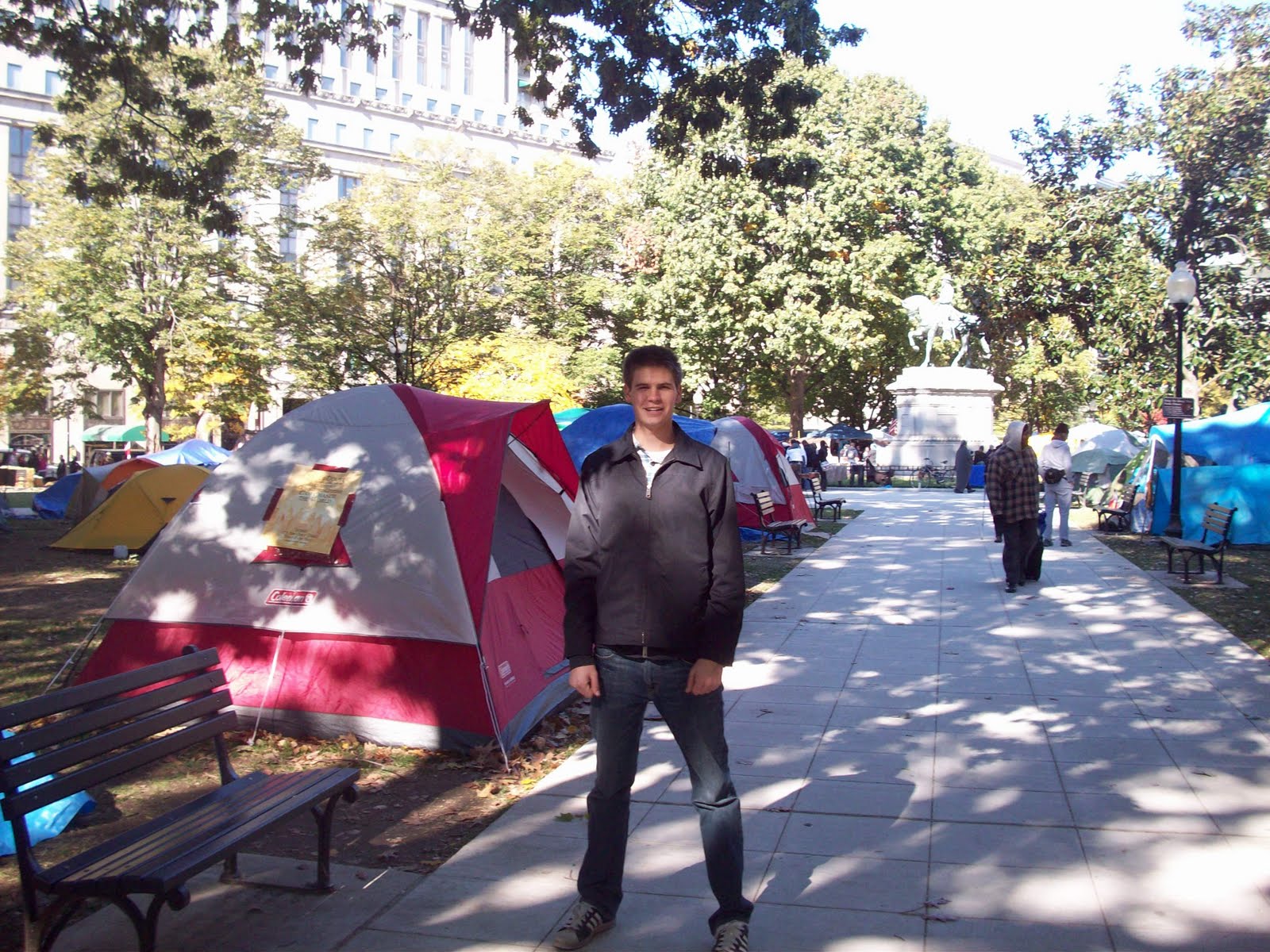
I went to Occupy DC today. Actually, today it was more like Occupy DC/Statehood for DC/Stop the Machine/Out of Afghanistan/Martin Luther King Jr. Dedication/Troy Davis was framed/Marxism, yay! The local DC political leadership decided to plan a march to call for DC statehood the day before the official dedication of the MLK Jr. monument. Of course, Occupy DC and all the other usual suspects had to join in.


It was fun.

---

"So, Joel, what do you think of the Occupy Wall Street movement?"

Why thanks for asking!

Occupy Wall Street is a grassroots, spontaneous outpouring of anger at the situation our country is in, and an acknowledgement that the democratic political process in the United States has failed. It has failed about as completely as it could without sparking an actual armed revolution.

The correct way to address grievances, we are told, is to lobby, write letters, and above all, vote. And vote we have. In 2008, after seven years of horrifically bloody war and the biggest economic disaster in eighty years, we replaced a WASP conservative president with our first minority president ever: a liberal, half-term senator of Muslim ancestry. If that wasn't a sign that the electorate was fed up with politics as usual, I don't know what could be.

That president has continued the last one's war policy almost unaltered - except for the new methods he has devised to flout the Constitution - and has done very little to help the millions of Americans facing unemployment or foreclosure, or hold accountable the financial sector that got us into this mess. So we voted the opposition party into power in Congress. In the past year and half, the opposition party has nearly shut down the federal government twice, nearly sent us into national debt default once, and has challenged the president on abortion, gay rights, healthcare, foreign policy, increased taxes on the rich - just about everything but help for the middle class and meaningful economic reform. Last week, after killing the president's plan to create more jobs, the Loyal Opposition unveiled its own job creation plan: repeal universal healthcare, add a balanced budget amendment to the Constitution, expand offshore drilling, and cut corporate taxes (in a year when GE paid NO TAXES WHATSOVER). Thanks, GOP! Glad you're taking our Third World unemployment rate so seriously.

9.1% of Americans are unemployed.

17.8% are underemployed

25% of American children are in poverty.

Average wages for middle class and poor Americans have declined by 7% and 12% respectively in the past decade.

800,000 homes will be foreclosed on this year. 1 million were last year.


All this, in the richest country on earth. That's insanity.

Mass unemployment and poverty is only the biggest crisis our country is facing. If we ever get it sorted out, we will have to proceed to tackle the debt crisis, the entitlements crisis, the immigration crisis, the environmental crisis, the education crisis, and so on. And once the crises are dealt with, we must address the host of fundamental, unspoken unjustices of the American system: regressive taxation, massive corporate subsidies that distort the free market and undermine developing economies around the world, a military budget that exceeds the combined military budgets of every other country on earth, military aid to dictators overseas, the war in Afghanistan/with Pakistan.

Do YOU think, based on the last three years, our political system is up to the challenge?

The normal political channels are not working. The media cycle, the campaign finance system, and the two-party power structure all conspire to ensure that no one who might actually fix things will win an election. The odds that the 2012 elections will bring in leadership who would enact true change are similar to the odds that the 2005 Egyptian elections would have.

And so, our dispossessed have opted for an Egyptian solution. Go outside the political process. Occupy a public space. Interrupt business as usual. Focus the attention of the media and the political class on real issues facing us, as opposed to fake ones. ("Will Sarah Palin run? Will Amanda Knox be released? Do conservatives think Obama is the Antichrist?")

Thus far, they have manifestly succeeded. And for that, they deserve our gratitude.

---

"What do the protestors want?" the media and conservative politicians ask over and over again. It's a fair question. I asked it myself when the protests were first starting. At that point, I didn't think they would come to anything. The fact that they have become a global phenomenon WITHOUT a clear set of demands or objectives is astonishing, and should tell us just how bad things have become. Grilling the Occupy Wall Street protestors should be the last thing on our minds. In a world in this state, we should be posing questions to our political and economic class, as they are.

But if the protestors refuse to make demands...then how does this end?

Keep in mind that the whole point of these protests is to effect change OUTSIDE the normal political/economic system. I found this statement on a pro-OWS blog: "Making demands is ultimately disempowering because it gives the other side the power to address or ignore them as they see fit."

Those words sound like academic bullhonkey at first blush. But I find them kind of chilling. By not making demands of those power, the protestors are declaring that they don't recognize the power of those in authority. Nothing short of unconditional surrender will do.

Carrying that thinking to its logical conclusion leaves us with nothing less than a dictatorship of the proleriat stepping in to assert the "General Will" of the people. Hey, it happened in Egypt and Libya.

Of course, that won't happen. But assuming these protests spread, it does give the powers that be extra incentive to make concessions, eh?

Tuesday, October 11, 2011

The Mask is Off و نشاهد الوجه الحقيقي

I spent more of my day than I'd like to admit translating a flurry of Facebook postings from my Egyptian Christian and Muslim friends. I learned a lot of new Arabic words - "cowardly," "dogs" [plurals are tricky] and a curse word that's pronounced "mdasesh" and isn't found in any of my dictionaries.

OK - some context.

On February 18, Hosni Mubarak stepped down as president of Egypt after three weeks of massive street protests, transferring power to a military council. The military council pledged to restore order and hold democratic elections after an appropriate transitionary period.

Since then, Egypt's economy has stalled, its violent crime rate has exploded, at least one person has been arrested and hauled before a military court for saying mean things about the army on his blog, and most worryingly, violence against Egypt's Christians (10% of the population) has spiraled out of control. Scores of Christians have been killed in attacks by Muslim extremists on churches, priests, and Christian homes.

Still, there was still a chance that Egypt's new military rulers were serious about steering Egypt towards a genuine, liberal democracy. The Egyptian people trusted them. I did too.

Sunday, that question was settled for us.

On Sunday, 1,000 Egyptians, mostly Christian, but also some Muslims, marched in Cairo to protest the burning of a church in southern Egypt by a Muslim mob on September 30. (There's a book I want these fanatics to read. It imparts insights like this: "لا اكراه في الدين.")
The protestors, quite understandably, demanded better protection for Christians from the government, an end to inflammatory rhetoric against Christians on state TV, and the sacking of a governor who incited the mob.

A few hours into the peaceful march, the protestors were assaulted by plainsclothed thugs. When the protestors tried to resist, the military suddenly appeared with tanks and guns. Troops fired indiscriminately into the crowd, and the tanks starting deliberately running over protestors. When it was all finished, around 25 people were dead.

Egypt's military rulers appear to have found a solution to the embarrasment of Muslim-on-Christian violence: kill the Christians until they shut up about it.

The revolution is betrayed. The Egyptian military, having prospered muchly under three decades of rule by Air Force commander Hosni Mubarak, owns anywhere between 5 and 30 percent of Egypt's economy. That's not a whacked-out conspiracy; that's life in the third world. It seems clear now that the Egyptian military's strategy to survive the revolution is, and has been from the start, to assume the role of the Guardian of Liberty, transfer political power to a democratically-elected government that's seen as legitimate by the people, then slip behind the curtain to enjoy its portion. Equal rights for Egypt's Christians have no place in that strategy. The military isn't about to risk upsetting the majority on their behalf.

After this massacre - judging by the press accounts there appears to be no other word for it - Egyptians of good will, Muslim and Christian, may unite again in Tahrir to demand the end of the military power structure. Or, maybe, the military will succeed in its intimidation strategy, hold elections as scheduled on November 28, and run off into the night, plunder in tow and minorities hung out to dry. They may get away with it.

But know this, ya mushir: there is a God in heaven, and there is a Judgment Day.

Thursday, October 6, 2011

The Weekly Standard explains why we should stick with Hamid Karzai

"In our time, political speech and writing are largely the defense of the indefensible. Things like the continuance of British rule in India, the Russian purges and deportations, the dropping of the atom bombs on Japan, can indeed be defended, but only by arguments which are too brutal for most people to face, and which do not square with the professed aims of the political parties. Thus political language has to consist largely of euphemism, question-begging and sheer cloudy vagueness."

- George Orwell, 1946

"At the center of any effort to build an independent Afghan state is [President] Hamid Karzai, who is much maligned for a realpolitik approach to statecraft, ties to corruption, and a changeable personality. But however correct these critiques may be, it is also true that Karzai is the product of a particular political system, a man with clear interests and largely predictable behavior and, crucially, whose political objects largely align with our own in the region."

- Richard Cleary and Thomas Donnelly on the Weekly Standard blog today

And translating into Old English: "Yes, Hamid Karzai is an election-stealing, drug-running, double-dealing thug, but he's the only political figure in the country who will do our bidding, and really, what can else can you expect from Muslims? Let's continue to send him American money and weapons and young American men and women to die defending his regime."

Ben Ali Mubarak Qaddafi Saddam Suharto Pinochet Arafat Diem Zia Reza Shah Ceaucescu the House of Saud Saleh Bashir Montt Mobutu Karimov Bakiyev Duvalier. Mind you, this is only off the top of my head.

How much longer are we going to do this, kids?

U.S. President Barack Obama and First Lady Michelle Obama With World Leaders at the Metropolitan Museum in New York
Obama and Michelle pose with this guy.